



at the source
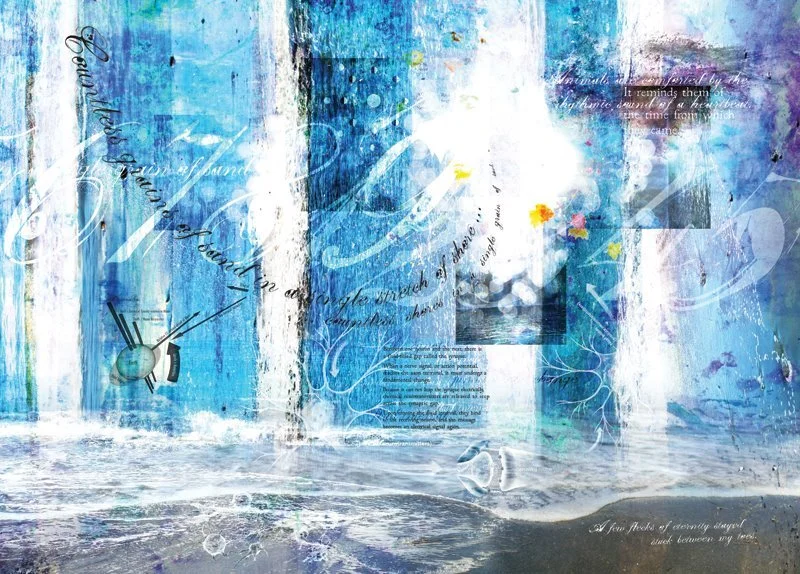
At the Source is about being at the edge of the ocean, and the way that feeling a sense of awe can affect our perspective. We are reminded of how small we are, and also how connected we are to the world — an inextricable part of something so much greater than us. The swirling type says “Countless grains of sand in a single stretch of shore… countless shores in a single grain of sand.”
This piece is about the desire to understand the patterns and causes of the tides, such as the ninth wave, and the low and high tides, as well as the experience beyond possible understanding. Type in the upper right area says “Animals are comforted by the rhythmic sound of a heartbeat. It reminds them of the time from which they came.”
It is about the comfort and awe of being at the source of all life: the feeling of the salty water and air healing the body, the wonder at its vast power, and the rhythm of the waves as a primal reassurance of our place in a great continuum.
“It is about the comfort and awe of being at the source of all life: the feeling of the salty water and air healing the body, the wonder at its vast power, and the rhythm of the waves as a primal reassurance of our place in a great continuum.”
At the Source also compares the idea of feeling small at the edge of a vast ocean with the purpose of neurons, those teeny-tiny very powerful cells that make us think and move and do everything we do. Between neurons, there is a fluid-filled gap called a synapse, which each sensation and message must cross (requiring a fundamental transformation) before even the potential for something can happen. Standing there at the edge, we can feel open to potential.
The type at the bottom says “A few flecks of eternity stayed stuck between my toes.” This represents the idea that this kind of realization can only happen when you’re actually there, physically present, at the ocean—at the source. It’s not enough to just have the thought. And although the new perspective might seem to be quite cerebral, it also has everything to do with physical sensation — which toes are especially great at. Lastly, after such a realization, we usually manage to take that sense of eternity and new perspective—at least a few flecks of it—with us when we return to inland life.
At the Source was created in Adobe Photoshop, where I combined my photos of the ocean, sand, some scans of textural paintings by my children, some diagrams of moons, tides and neurons, and type.